Commander decks in Magic: The Gathering are 100 cards led by one legendary commander, and there are three ways to get one: buy a preconstructed deck, copy a list someone else built, or build your own. This guide covers all three, what a working deck needs inside those 100 cards, how to match it to the people you play with, and how to test it before you buy a single card.
I build EDHMat, a free browser table for Magic EDH online, so the testing section uses it; everything else applies wherever you play.
New to Commander decks? Start with what a Commander deck is and the three ways to get one.
Building your first deck? Go to building a deck step by step and matching it to your pod.
Want to try a deck first? Jump to testing a deck before you buy the cards.
What is a Magic the Gathering Commander deck?
A Magic: The Gathering Commander deck is a 100-card singleton deck led by a legendary creature, its commander, and every card has to fit the commander's color identity. Commander is MTG's most popular multiplayer format, and decks range from ready-to-play precons to tuned competitive (cEDH) builds.
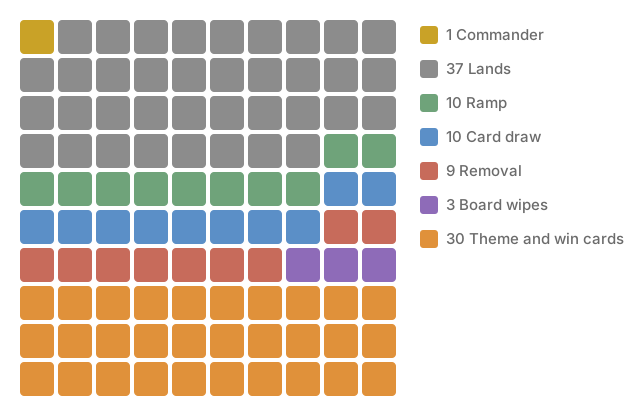
Inside the 99, most decks follow the same shape: about 37 lands, 10 ramp cards, 10 card draw, 8–10 removal spells and 2–3 board wipes, with the rest spent on the theme. None of these numbers is a rule. They're where most builders start before adjusting to their deck.
| Card role | Typical count | What it does | Example |
|---|---|---|---|
| Lands | 36–38 | Your mana, one land a turn | Command Tower |
| Ramp | about 10 | More mana than one land a turn | Sol Ring, Arcane Signet |
| Card draw | about 10 | Keeps your hand full through a long game | Harmonize |
| Removal | 8–10 | Deals with one problem card | Swords to Plowshares, Beast Within |
| Board wipes | 2–3 | Resets the board when you're behind | Wrath of God, Blasphemous Act |
| Theme and win cards | about 30 | What makes the deck yours, and how it wins | Depends on your commander |
Think of the 99 as a set of jobs: the first five rows keep a deck working, and the last row makes it yours. The one job I'd never save on is lands. Take the recommended count and stick to it, because a game without land drops is usually lost in the first few turns.
The rules every Commander deck follows
Every Magic the Gathering Commander deck follows three building rules. Each card has to fit your commander's color identity, there's only one copy of each card apart from basic lands, and cards on the Commander banned list stay out.
That's the whole deck-building rulebook. How to play EDH covers the rest of the format for beginners, including the color identity details that catch people out. Wizards keeps the official summary on its Commander format page.
Three ways to get a Commander deck
There's no wrong way in, and most players end up doing all three over time. The right first route depends on your budget, your time and how much you want to learn by doing.
| Route | What you spend | Time to a first game | What you learn | Good for |
|---|---|---|---|---|
| Buy a precon | One boxed deck | Minutes | How a finished deck plays | Your first deck |
| Copy a list | The singles you don't own | Days, while cards arrive | Why strong lists look the way they do | A commander you already like |
| Build your own | Singles, plus a lot of choices | Days to weeks | The most, including from mistakes | Your second or third deck |
Preconstructed decks: are they worth buying?
For a first deck, usually yes. A precon (preconstructed deck) is the cheapest way to get 100 cards designed to work together, and you can play it the day you open it. Wizards releases several alongside most new sets, plus Starter Commander Decks aimed at new players. My guide to precon Commander decks goes through this year's decks and how to pick one.
A precon is less worth it when you already own most of its cards, or when you only want one card out of the box. It also makes a good base to upgrade: swap about ten cards at a time and play between changes, so you can see what each swap does.
My own first deck was a precon built around Pantlaza, Sun-Favored, and it played well straight out of the box. Later I upgraded it with single cards from Cardmarket, picked after watching YouTube videos and reading community posts about that exact deck.
Copying a list someone else built
Copying a decklist, often called netdecking, is a normal way to start. Moxfield and Archidekt hold thousands of public lists for almost every commander, and EDHREC shows which cards most decks for a commander play.
The catch is cost. You're buying singles, and a list tuned by someone else can hold cards far above what your table plays. Read the list before you order anything, and cut what you can't explain yet.
Building your own from scratch
Building your own takes the longest and teaches the most. You'll pick every card, which means you'll also pick some wrong ones, and finding those is part of the process.
Most people build their second or third deck this way, once they know how a precon plays. The next section walks through it step by step.
How to build Commander decks, step by step
Five steps, in the order that saves the most rework. You can do all of it in a free deck builder like Moxfield or Archidekt before you own a single card.
Pick a commander you want to see every game
Your commander is the one card you'll see in every game, so pick one you enjoy playing, not only one that's strong. Its colors set the color identity of the whole deck, and its abilities usually hint at what the deck wants to do.
Fewer colors are easier to build: a two-color deck needs far less mana fixing than a four-color one. If you're torn between two commanders, build the one whose rules text you understand completely.
I picked Pantlaza because I like getting extra cards, and its discover ability hands you a free card whenever a Dinosaur enters. In hindsight it costs a lot of mana and can take a while to arrive; once it's out it's great fun, but next time I'd try a commander that does more in the early turns.
Decide how the deck wins
Before you pick cards, write down in one sentence how the deck ends a game. "Make lots of tokens, then attack with all of them" is a plan; "play good cards" isn't.
Include several cards that can close a game, so a single removal spell doesn't end your plan. If you can't name them, the deck will stall at exactly the point where it should win.
Fill the jobs before the theme
This is where most first decks go wrong. It's tempting to start with 60 exciting theme cards, then find there's no room left for ramp, draw and removal.
Do it the other way round: fill the job squares in the grid above first, then spend what's left on the theme. Cards that do a job and fit the theme at once are the best cards in any deck, so look for those first.
Build the mana: lands, ramp and colors
Start at 37 lands and about 10 ramp cards. Only a deck full of very cheap spells gets away with 34 or 35; an expensive commander or three or more colors want 38 or more.
Count the colored mana symbols in your deck and split your basic lands in roughly the same ratio. Command Tower and Arcane Signet belong in almost every multicolor deck, because both make any color your commander has.
Cut down to 100
First lists often end up well over 100 cards. Cut the most expensive theme cards first, and keep the ones that do two jobs.
When you can't decide, play the deck and cut the cards that sat in your hand. That's where testing comes in, further down this page.
Match your deck to the people you play with
A Commander game works best when the decks at the table are at a similar strength. The same list can be a great deck in one pod and a frustrating one in another, so the strength that matters is relative to the people you play with.
Is there a best Commander deck?
Not one that fits every table. The strongest decks are cEDH decks, built to win as fast and as reliably as possible, and the cEDH community tracks which of them do best in tournaments.
For a casual pod, the best deck is one that wins sometimes, loses sometimes and keeps games fun for everyone. A combo deck that ends every game on turn five is strong, but it's rarely welcome at a table of precons.
Power levels, the 75% rule and Commander Brackets
The 75% rule is an informal Commander idea: build your deck at roughly three quarters of the strongest version it could be, so it can win games without running over a casual table. It was never an official measure, and players rarely agreed on what 75% meant. Wizards' Commander Brackets now give pods a shared scale instead, from 1 to 5.
The brackets are Exhibition, Core, Upgraded, Optimized and cEDH. Brackets 1 and 2 leave out the cards on Wizards' Game Changers list, bracket 3 allows up to three of them, and brackets 4 and 5 don't limit them.
Upgrades move a deck up this scale fast: my Pantlaza precon went from bracket 2 to the high end of bracket 3 after a handful of new cards, which is unfair against untouched precons. Before buying upgrades, think about your friends' decks, and watch the Game Changers, since one or two can lift a deck a whole bracket.
Decks for two, four or six players
Commander isn't a four-player format: it works with two players or more, and the size of the table changes which cards are good. Cards that say "each opponent" and board wipes get stronger as the table grows, because they hit more players and more permanents at once.
In a two-player game, speed matters more and those same cards do less. At five or six players you face threats from more directions between your turns, so cheap interaction and ways to protect your commander earn their slots.
If your group's size changes from week to week, build for the middle and keep a few flexible cards in the list.
The five-minute talk before the first game
The easiest way to match decks is to talk before anyone shuffles. A few questions are enough:
- Which bracket is your deck?
- How does it win, and roughly by which turn?
- Does it run infinite combos, extra turns or mass land destruction? Tables tend to feel strongly about these.
- Is anyone bringing a brand-new, untested deck?
If your pod is spread out, how to play Commander online compares the ways to play together, and where to play Commander online lists them by name. For game nights that run from a server, see how to play MTG over Discord.
Test a deck before you buy the cards
The expensive part of Commander is rarely the first deck; it's the single cards you buy afterwards to upgrade it. A few of them can also push a deck up a bracket, so it's worth seeing how a list plays before you order anything.
MTG Arena's Brawl lets you try ideas against real players, but it's one against one and only has Arena's cards. I built EDHMat so my own pod could keep playing Commander together when we couldn't sit at one table, and a deck there is just a pasted list, so it can include cards none of you own yet.
Try upgrades before you order them
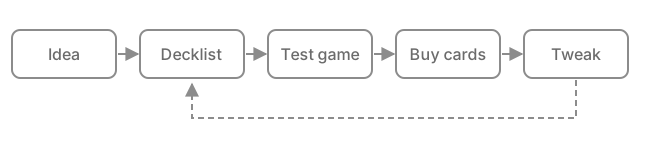
Add the cards you're thinking of buying to your list, paste it into a table and play a game or two with your pod. You'll see whether the new cards change games the way the videos promised, and whether the deck still fits the table.
The log keeps a record of the game, so afterwards you can scroll back and check:
- Did you make a land drop on each of the first four turns?
- On which turn could you cast your commander?
- Which cards sat in your hand all game?
- Did the new cards do anything when they showed up?
Try a precon before you buy it
Decklists for precon Commander decks are published when the decks come out, and they're easy to find on Moxfield and Archidekt. Paste one in and play it against your friends' decks, so you know whether it suits you and your table before you buy the box.
When the deck is ready
For a first game with your pod, Commander online walks through it step by step. If you're still weighing a browser table against MTGO, Arena or webcams, MTG Commander online compares them.
Pods that play paper decks over webcam will find more options on the SpellTable alternatives page.
Paste a list, open a table and play it with your pod before you order a single card. No account needed.
Open a tableYour decklist is a text file
Whichever deck builder you use, a deck travels as plain text: one line per card, like 1 Sol Ring (LTC) 284. The quantity and the name are what matter; the set code and number are optional.
That text is also how a deck gets onto a table. On EDHMat you paste the export from Moxfield, Archidekt or MTG Arena, or an Archidekt link; Moxfield links don't work, because Moxfield's API sits behind Cloudflare, but its text export does. Importing a decklist covers the details.
Two things happen to the list on the way in. Each card resolves to its plainest printing, since in one test game Command Tower turned up in its Marvel printing; and cards named in German, French, Italian, Spanish, Portuguese, Japanese or Simplified Chinese are dealt in that language.
Five things that go wrong in a first Commander deck
I didn't run into these myself, because I started with a precon. One that roughly fits how you like to play is a solid way in: it's hard to get much wrong, and you can upgrade it one card at a time. If you build from scratch, check your list against these five before its first game.
- Too few lands. Cutting a land for "one more spell" is the most common mistake. Start at 37 and only go lower with a reason.
- Too many expensive cards. A hand of six- and seven-drops does nothing for five turns. Swap some for cheaper cards that do the same job.
- No way to answer threats. Without removal and a couple of board wipes, the first strong card an opponent plays decides the game.
- A theme without a finish. Thirty cards that fit the theme but none that win leave you with a nice board and no way to end the game.
- A deck far stronger than the table. It wins, but nobody wants to play against it twice. Check your bracket before you sit down.
Deck words you'll hear
- Precon: a preconstructed deck, sold ready to play.
- The 99: every card in the deck except the commander.
- Singleton: one copy of each card, the rule Commander is built on.
- Netdecking: copying a decklist someone else built.
- Staples: cards that turn up in almost every deck of their colors, like Sol Ring.
- Game Changer: a card on Wizards' list of cards that push a deck into a higher bracket.
- Bracket: one of the five official power levels for Commander decks.
- cEDH: competitive EDH, decks built to win as fast and as reliably as possible.
- 75% deck: the older, informal way of saying "strong, but not all-out".
- Pubstomp: a very strong deck played against a casual table.
Whichever way you get your deck, the first game with it will tell you more than any list, so find the people you play with and deal a hand.
More guides on Commander decks
Guides on single parts of deck building are listed here as they're published. Until then, the Commander guides cover the rules, deck imports and playing with your pod.
Frequently asked questions
What are Commander decks in MTG?
A Commander deck is a 100-card singleton deck led by a legendary creature, its commander. Every card has to fit the commander's color identity, and apart from basic lands there is only one copy of each card.
Is a Commander precon worth buying?
For a first deck, usually yes. A precon is the cheapest way to get 100 cards designed to work together, and it makes a good base to upgrade. It is less worth it if you already own most of the cards in it.
What does the 75% rule mean in Commander?
It is an informal idea: build your deck at about three quarters of the strongest version it could be, so it can win without running over a casual table. It was never official, and Wizards' Commander Brackets now give pods a shared scale instead.
Which Commander deck is the best?
There is no single best deck for every table. The strongest decks are cEDH decks, but for a casual pod the best deck is one at a similar strength to everyone else's.
How many lands should a Commander deck have?
Start at about 37 lands with around 10 ramp cards, then adjust. A deck of cheap spells can go down to 34 or 35; an expensive commander or many colors want 38 or more.
Can I test a Commander deck without owning the cards?
Yes. Build the list in a free deck builder, then paste it into a browser table like EDHMat and play it with your pod, with no account. Cards you are thinking of buying are just lines in the list, and you can try a precon the same way before buying the box.
Can you play a Commander deck with only two players?
Yes. Commander works with two players or more. Four is common, but table size mostly changes which cards are strong, not whether the format works.